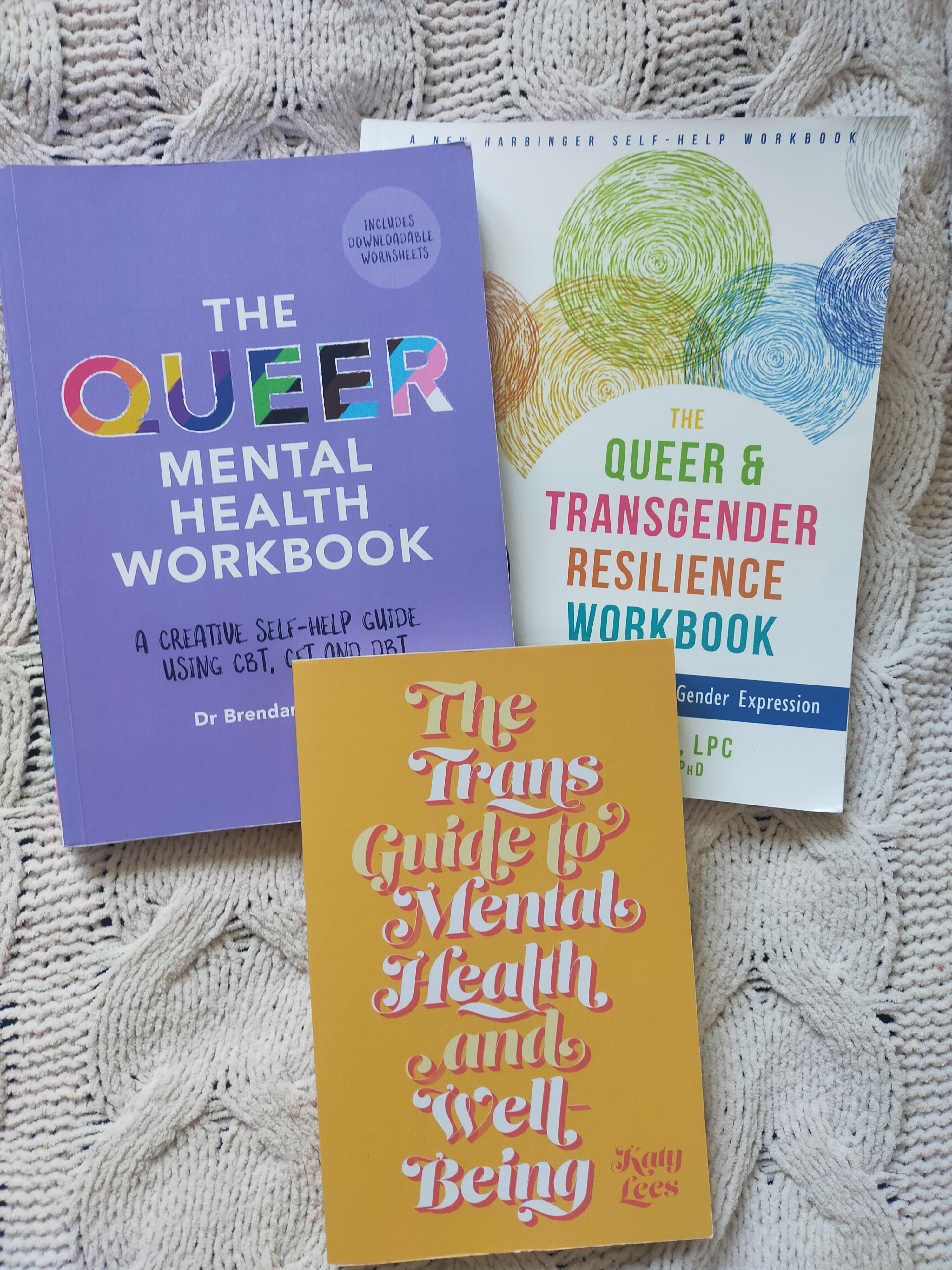
Self-help books can play an important role in helping understand ourselves, especially when therapy isn’t available.

In yoga philosophy, the principle of Svadhyaya is all about knowing yourself. This is the fourth of the Niyamas, which are a set of guidelines for living well. Self-help books like those pictured above can form part of our Svadhyaya practice as queer yogis.
Every time we come to our yoga mat or chair, we’re aiming to keep an open mind to receive new information about ourselves. Each Asana, or posture, gives us an opportunity to learn something about experience of being an embodied human.
As we navigate the world, we encounter new people, places, fashion, art, new ways of thinking, speaking and being. All this input can help to shape or reshape our understanding of ourselves if we can stay open to these new perspectives.
Practicing on the yoga mat or chair is literally a practice where we unlearn and relearn. Looking through these self-help books can feel like as much of a new shape as any forward fold or heart opener we might practice on the mat or chair. So let’s dive right into the first of the three books pictured above.
The Queer Mental Health Workbook

The Queer Mental Health Workbook by Dr Brendan J Dunlop is full of exercises which you can complete within the pages of the book, or you can download worksheets if you prefer.
I particularly enjoy the chapter on intersectionality. There’s a worksheet which encourages you to think about your characteristics and identities, how you express your characteristics in the world, and your power and privilege in the world.
The intersectionality chapter continues with more journal style questions around how you feel about you identity, and how this connects to your well-being. This feels really holistic with a 360 degree perspective on who you are as a queer person. I enjoy the way this book makes space for all the layers of complexity and nuance, even sometimes the contradictions inherent in being a messy queer human.
The chapters cover a broad range of themes including identity, queer relationships, feeling anxious, feeling low, sleep difficulties, shame, trauma, and others. Some of the topics are pretty heavy but could potentially be life-saving.
The Queer and Transgender Resilience Workbook

Anneliese Singh is the author of this workbook, which includes noticing activities, e.g. ‘notice how your thoughts cause your feelings’, as well as covering practical exercises, such as ‘developing a personal definition of assertiveness’.
At first, the focus on resilience sounded a bit hard to me, but the book’s approach is softer than the word ‘resilience’ might imply. Resilience Practices throughout the book include topics such as ‘setting boundaries about your identities’ and ‘personal feel-good mantras that inspire you’.
I enjoy the real world links made throughout the book. So, instead of just talking about assertiveness in the abstract, the workbook demonstrates how assertiveness can help address issues such as misgendering, a lack of safe LGBTQIA+ space in a college setting, or being treated well on a date.
Topics throughout the Queer and Transgender Resilience Workbook include knowing your self-worth, standing up for yourself, affirming and enjoying your body, building relationships and creating community, and getting support and knowing your resources.
The Trans Guide to Mental Health and Well-being

This is a gorgeous resource by Katy Lees, which is more of a book than a workbook. There’s a difference in tone compared to the workbooks mentioned above. Katy is a non-binary therapist and the book is infused with a sense of their own lived experiences as a Trans+ person as well as their professional expertise.
I love the way it feels like they are talking heart to heart, but maybe that’s my perspective as a non-binary reader, enjoying a non-binary author. There’s no lack of academic content; The Trans Guide to Mental Health and Well-being is packed full of references to psychotherapy research. But somehow Katy makes it all feel very accessible.
I enjoy dipping into this book when I’m in need of a pick-me-up. The way that the author talks directly to me helps me to feel more confident. For example, when discussing trauma and how it can make people feel helpless or powerless, there’s a pep talk which gives me goosebumps:
Luckily, you’re already stronger and more in control than you probably think you are, just by being yourself! Being trans is so powerful (Roche 2019) – you get to make so many choices about who you are and where you want to end up.
Isn’t that beautiful? To find out more about Katy’s psychotherapy work, check out their website here. Also, they have a new book out in October 2025, called Queer Minds, which you can pre-order here.
Queer Yoga
Talking of pre-ordering… a quick reminder that you can pre-order my first book, Queer Yoga, which is due April 2026.
Queer Yoga is a self-help book of sorts, from a yogic perspective, with journal prompts and practical rituals to help take yoga off the mat or chair.
Pre-order Queer Yoga from Amazon, Barnes & Noble, or direct from the publisher at Llewellyn Worldwide.

Leave a Reply