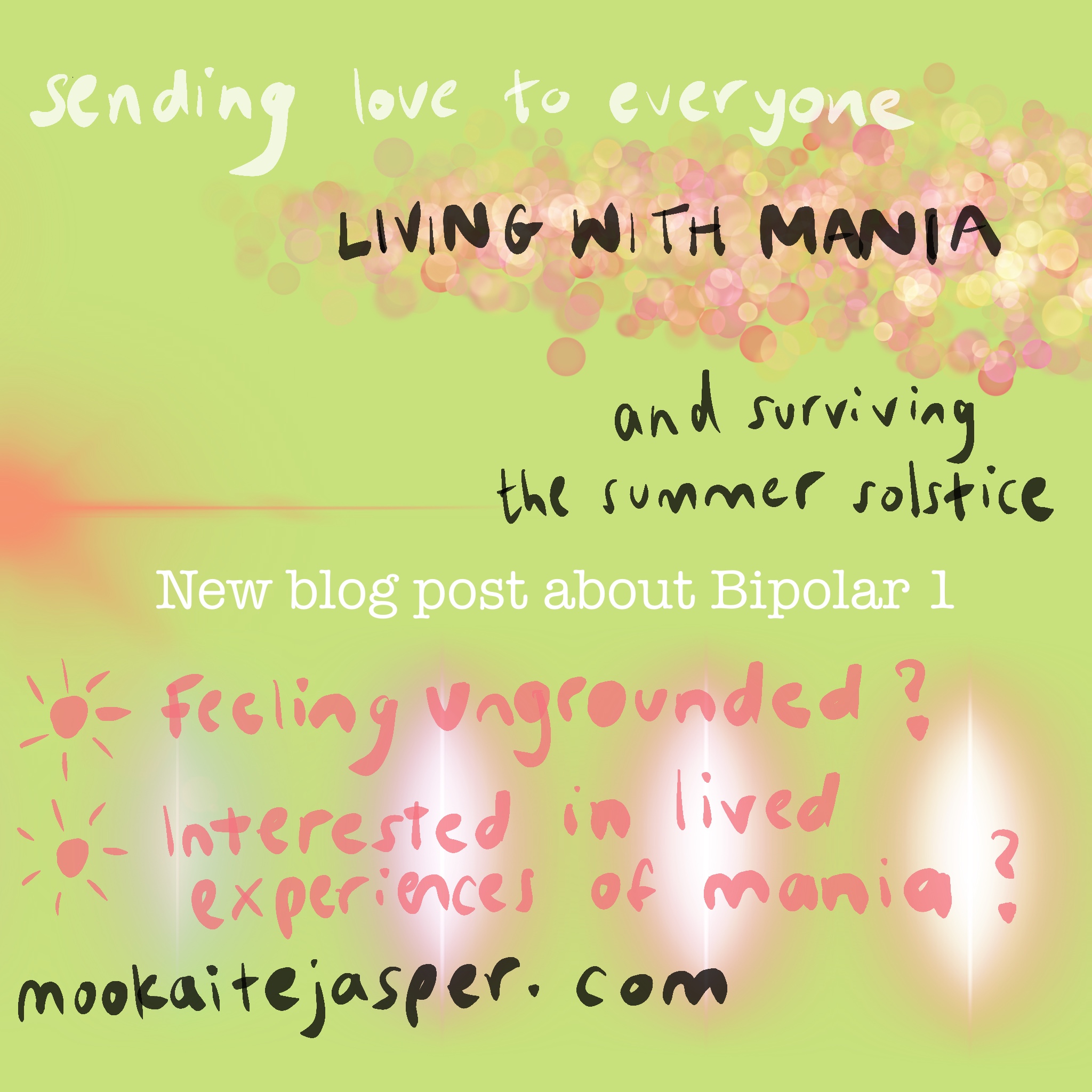
Today marks the longest day of the year in the UK, where I live. This is the day when the sun is at its peak in the Northern Hemisphere – and for me personally, with bipolar 1, this is the hardest time of the year. If you’re struggling, remember that you are not alone. Help is out there. You can jump straight to helpline numbers below.

Mania is very scary. Most people don’t know what they’re saying when they causally use the word ‘manic’ to mean busy. But I wonder how many people without bipolar do find the summer solstice challenging too?
What is bipolar 1?
Bipolar 1 is characterised by having experienced at least one episode of mania which has lasted longer than a week, according to Mind’s website. I was diagnosed with bipolar 1 after my first episode, and I went on to have a second major episode after that.
I feel like there’s slowly more awareness now about depression, although I don’t experience depression with my bipolar. I’m sure there is still a huge amount of misunderstanding around depression. With mania, it’s an upward energy and I think most people associate this with positive feelings, so it’s hard for people to view upward energy as something that can become dangerous.
Yes, joy and celebration and dancing and singing and socialising are all a wonderful part of the human experience. But if you have a tendency to mania, too much of a good thing can become really dangerous, really fast.
Depression vs Mania
My wariness around the summer solstice comes only from my lived experience. I’m not a mental health professional and I haven’t done studied mental health. What I’m sharing here is my personal experience and might be totally different to someone else with a diagnosis of bipolar 1. However, I do feel that speaking more openly about mental health in this way can help to reduce the stigma. Maybe sharing my experiences around mania can help raise awareness that not all mental health issues look like depression.
My understanding is that some people with depression can find the darkness of winter challenging for their mental health. For me, summer is the season that I dread. The upward energy of mania is exacerbated for me by the light and long days of summer. In the UK, sunset tonight on the Summer Solstice is at 21.22 in London, and even later at 21.49 in Newcastle, in the North East of England where I live. Sunrise in London this morning was at 04.43 in London, and even earlier at 04.27 in Newcastle. That’s a LOT of sunlight!
In the past, I didn’t know I had bipolar and I wasn’t as connected to myself through practices like yoga. At that time, the strong solar energy of the summer solstice would have seen me out dancing on the beach, partying in the forest, as well as dashing from bar to nightclub to work to bar to nightclub, lapping up the social scene of wherever I happened to wash up that night.
In the end, my chaotic lifestyle obviously took its toll and my world imploded when I had my first manic episode. There’s a misconception that mania makes people dangerous to others. I was a danger to myself, for sure. No one else was in danger, although I was lucky to have a loving partner who was scared *for* me, and got me hospitalised. Although hospital with an SMI isn’t easy, I’m always grateful for the medical attention I received before I could endanger myself anymore.
tackling the stigma
I wonder how many people have not sought or not been offered the care they needed because of the stigma around being diagnosed with a Severe Mental Illness (SMI)? I fear that stigma and taboos around mental health cause too many tragedies. It’s heartbreaking when you understand the consequences of mania. I don’t remember everything that happened when I was manic, but I have been told what could have happened to me if I hadn’t been lucky enough to be hospitalised. That’s why I’m so passionate about yoga.
Yoga (in its broadest sense), coupled with medication and professional support, helps me now navigate the summer more safely.
Hospitalisation for mental health isn’t easy for anyone, but I’m glad my partner got me taken there.
How do I celebrate the summer solstice?
Mainly by focusing on getting through it. I genuinely feel a bit fearful of this season. The summer solstice feels like this hurdle to overcome. I’m relieved the light will start to draw in now and the days will shorten, perhaps like someone with depression will look forward to the return of the light in spring.
I don’t celebrate the solstice by getting up crazy early for the sunrise, or staying out to witness the late sunset. Sleep routines are my number one priority.
Celebrating the summer solstice for me is about relief and gratitude, in the knowledge that I’m one of the luckiest. Too many people don’t have the support I’ve been afforded. I’m glad to be here this summer solstice…
- to experience love
- to admire nature
- to read books
- to be in my body
- to taste fresh fruit
- and to take some deep breaths.
I want to get through this summer and the next one, and the one after that. And I don’t only want to enjoy these simple pleasures, but I also want to be of service.
People with SMIs are creative, valuable humans who deserve respect, dignity, and to have a chance to play a part in society, whatever that might be. It’s just that the rigid structures and the productivity priorities of a capitalist world sometimes make it hard for us to contribute. But we do have a huge contributions to offer.
If you’re reading this as someone with bipolar, or any mental health condition, know that you are precious and much needed here in this world right now. We are not the problem. We are part of the solution.
Yang Energy and Bipolar
In yoga, we sometimes talk about yin energy and yang energy. Yang is a harder, more active, more ‘do-ing’ kind of energy. Our society is pretty yang overall. The energy of the summer solstice is also very yang. This yang energy isn’t a bad thing in itself, but we need balance.
For someone like me, with bipolar 1, yang energy is very alluring. This Pride Month, part of me would love to go join every single protest, marching on the streets in community, shouting and chanting. I’d love to join in the International Day of Yoga celebrations today. But every year, I am slowly developing more discipline to cultivate the yin, and say no to the invites, and above all say no to the inner tug towards the wild.
In our yang-y society, I wonder how many people without bipolar do still experience ‘manic-like’ feelings around this time of year? Now I’m more attuned to my own manic tendancies, I see ‘manic-like’ behaviour all around me at this time of year.
In the UK, the word ‘manic’ is often used in slang to describe people feeling hurried and busy. It used to be jarring for me, after I actually experienced mania, to hear people throw the word around without knowing what it really means. But I can tolerate people using the word ‘manic’ these days, and maybe people throwing the word around are on their way to becoming truly manic? Who am I to say? Certainly when I experienced mania, I never thought it would happen to me.
If you feel you can’t cope right now, I urge you to reach for support. Seek help even if you don’t have a diagnosis of bipolar or any other mental health condition:
get help
- Call your mental health professionals, if you’re already receiving care.
- Call your local Crisis Team in the UK. If you don’t know your local Crisis Team, call 111 in the UK.
- Call Samaritans helpline 24 hours a day in the UK: 116 123
- Articulate your feelings to someone trusted. Even if what’s in your head feels crazy, it’s safer to say it aloud to someone trusted, so they can help you, without judgement. If you don’t have someone nearby who is trusted, then call a helpline like Samaritans above.
Things That Help Me
Here are some things which help keep me safe at this tricky time of year, but these are just my lived experiences, not advice, and cannot replace medical advice or medication. There can be stigma around medication but it can be life saving. Personally, I take medication for bipolar and this supports me in doing the things listed below:
- Tracking my mood every day in a mood journal. Bipolar UK has a free template.
- Getting into my body.
- Providing a list of triggers / warning signs / details of my medications and healthcare providers to a few trusted people. Essentially, this is a safety plan. You can download a free safety plan template from Samaritans.
- Speaking to people about my mental health, even when I really don’t want to.
- Having stable daily routines and monitoring my routines. Tracking routines helps me notice patterns when I’m struggling to stick to them, which can be a warning sign that I’m becoming ungrounded.
- Having a safety routine which I practice when I’m feeling grounded, so I can access this routine when I feel ungrounded. Click here to jump below for a full explanation of this.
- Keeping emergency medication on me at all times.
- Keeping helpline numbers in my phone.
Food is really important for me. Eating simple, home-cooked food with fresh ingredients helps prevent me becoming ungrounded. But if I’ve already become ungrounded, I find it harder to eat and can only eat very simple, fresh things. When I’m ungrounded, it’s like all my senses are super sensitive, so I can’t tolerate strong flavours or too much spice. If I’m struggling, the kinds of things I’ll eat is a plain jacket potato, or steamed broccoli on rice.
My personal understanding of bipolar is that it’s about energy. Food is an important aspect of energy, so eating regularly and eating home-made food is really important for me in staying grounded. I find that the energy of processed food or take-out food impacts my capacity to stay grounded.
I’ve learned a lot from the simplicity of ayurvedic cooking. I particularly like Kate O’Donnell’s book: The Everyday Ayurveda Cookbook.
Food and mania is one of the many reasons I get frustrated when people comment on other people’s weight. If I’ve lost weight, it’s a sign that I’m probably more manic. People who think they’re ‘complimenting’ me on having lost weight are problematic on so many levels. In relation to mania, for me personally, losing weight can be an indicator that I’m not well. Commenting on other people’s bodies is rude, ignorant, and can be dangerous for various reasons which are beyond the scope of this post. Getting angry isn’t great for my upward energy either, so I’m going to park those thoughts for now!
Back to staying safe this summer solstice, here are some other things that help me to feel grounded:
- Being wary of too much sugar.
- Avoiding caffeine.
- No alcohol.
- Gentle, slow movement practices like some kinds of yoga.
- Connecting to nature, even just bare feet on grass.
- Using language which I find more empowering and less pathologising. I tend to speak about being ‘grounded’ or ‘ungrounded’ these days, since I haven’t had an episode of mania for a long time now.
- Avoiding shops / shopping (basically avoiding any kind of dopamine hit)
- Being wary of too much travel.
- Avoiding crowds.
- Being wary of too much socialising.
- Being wary of too much time on screens and social media.
- Being disciplined with routines, especially around meals and sleep.
When I say ‘being wary’, I mean that I weigh up carefully the benefits vs. the risks of things like socialising and travel. If I choose to do something that will potentially de-stabalise my routines or my energy, then I try to mitigate for this by ringfencing rest time before and after. This can be tricky if your work is inherently social.
My understanding from speaking to people living with chronic pain / chronic fatigue / disability etc. is that they also have to be discerning in choosing how to spend their energy. I’m non-disabled but I feel like the difference with preventing mania is that I *could* theoretically go and do everything I wanted – oh, and I have wanted to do it ALL, believe me! That’s how I ended in hospital, because I was able to operate at 110% constantly.
Indeed, I’d argue that our society applauds people like me when we’re operating in a slightly manic state and can be super productive. But it’s not sustainable, and if you take it to the extreme and become manic, it can be very dangerous and the situation can deteriorate rapidly.
Mania, in my experience, can escalate fast, and that’s why I practice a safety routine.
My Safety Routine
Because I’ve had two significant episodes, I know a bit more about what to expect if I ever have another episode again. I hope it will never happen. I really, really hope that all my preventative measures mean I’ll never get to that point. But I don’t take my mental for granted – it takes daily discipline to stay well.
Just in case I do ever become manic again, I’ve recently started practicing a safety routine. It’s a bit like a fire drill, but for mania. The idea is that hopefully I’m developing automaticity around what I need to do if I start becoming manic. I was inspired by the earthquake drills when I was a teacher in Japan, and we had to practice with the children about how to stay safe in the event of an earthquake.
I keep helpline numbers in a little notebook, which also includes phone numbers for my trusted people, and affirmations that I’ve written for myself to help stay grounded. I have two copies of the same handwritten notebook – one is in my everyday backpack, that I always carry around, along with extra emergency medication. The other copy of that notebook is in my safety bag, and I read over the book as part of my routine drill.
There’s also emergency medication in my safety bag and a few other things that help me feel grounded. In the notebook, I’ve written down my drill which involves specific breathing exercises in a set sequence which help me to stay grounded. It’s really personal and I’m sure other people will have their own ways of coming into their body, to stay in reality. I’m not going to share my exact routine because I’m not a healthcare professional – my sequence is just what helps me. My hope is that practicing this sequence might hook it somewhere in my brain, so that I might slow down and remember it in a moment of crisis.
I have no idea if this drill would work if I actually became manic, because it’s never been put to the test. It’s worth saying that I only rehearse this drill at times when I’m feeling super grounded, so there’s an association of being grounded within this routine. For example, I sometimes practice it after I’ve done my usual daily yoga practice.
I take the bag if I ever stay overnight anywhere new, just in case I become unwell. This also gives me the chance to practice the drill in an unfamiliar environment if I’m feeling well enough. I try to practice both indoors and outdoors.
A Word on Sleep
Sleep, for me, is crucial. Of course, everyone needs sleep. But when I’m wired and can’t sleep, this is both a sign I’m becoming manic and is also likely to exacerbate the mania. Lack of sleep is both a trigger and a symptom of mania for me, which means it can become a vicious upward spiral:
if I’m becoming manic, I can’t sleep…
…and because I can’t sleep, I become more manic…
…which means I’ve got less chance of sleeping, and so on.
I have to break the cycle somehow, and it can be quite tricky, and for me, sometimes means seeking medical help to avoid this cycle becoming a full-blown manic episode. For me, sleep is my number one priority.
The Mind website has tips for improving sleep.
Again, it’s personal and I don’t want to appear prescriptive by sharing my own routine, because just to reiterate, this article is based only on my lived experience and I’m not a mental health expert.
However, one thing I’d say is that although routines are extremely important for me, in terms of creating stability, my routines do not come above sleep. So, if I have the urge to rest, lie down, sleep, or lie in, in the cases when my work schedule permits this possibility, then I try to honour that urge – even if it means changing my routine that day.
I know, as someone prone to mania, that I’m unlikely to ever want too much sleep. As I said, I experience bipolar without depression, but I wonder if the relationship with sleep might be different for someone who has depression.
For me, mania has been characterised by feeling I don’t need to sleep. When my life was really chaotic, sleep was sometimes not on the agenda at all. Sleep seemed like a bit of a waste of time when there was a million and one other things I’d rather be doing! Of course, it’s no wonder I ended up in hospital.
It’s really rare for me to nap. But I’m trying to do more yoga nidra during the daytime this summer, to see if that might create some kind of a nap. Yoga nidra is sometimes called ‘sleep yoga’. There are lots of resources out there to find relaxation, such as body scans and guided relaxations. It’s about finding what works best for you.
Find Your Yoga
Yoga teachers who advocate for rest, such as Jessamyn Stanley, are champions in this push back against the societal pressure to ‘do more’. Jessamyn has an online platform for inclusive yoga called The Underbelly Yoga which actually has gentle yoga practices specifically designed to unwind for bed.
Find a teacher who works for your energetic needs – ‘yoga’ is a vast umbrella term, and many yoga classes are way too uplifting for me. I do need to get in my body, but moving more slowly is important for me during the summer. I started doing qigong recently, and that has been grounding.
Meditation helps me to centre myself, but I am careful about not sitting and meditating for too long at once, because I need to remain very embodied. Personally, daily meditation for less time, like ten minutes, or maximum two x ten minute blocks per day, is best for me. Again, it’s super individual. I’m just sharing this because I often hear people celebrating the virtues of seated meditation for mental health. But it isn’t a one size fits all. You’ve got to experiment and explore what works for you.
Hats Off To Everyone Resting Today
As someone with a tendency to mania, it requires a huge amount of self-discipline to not give into the urges to do everything, be everywhere, solve everything, join every new project, visit everyone, etc. It’s tempting, not least of all because it’s often rewarded (financially or otherwise) and seen as a marker of success to be able to juggle so much.
For example, some people see it as a marker of success to finish writing a book. In my experience, as someone with bipolar, it is easier for me to write one full book than to take one full day of rest.
This is not an exaggeration.
Some people would say it’s a kind of bipolar super power to be able to write so fast – maybe it is, and it does sometimes come in handy! But honestly, I am more proud of myself for taking rest today than writing this blog post, because for me, there’s more discipline required to rest.
It’s radical and counter-cultural to look outside the window on a blazing hot sunny June Saturday in the UK, like today, and say, “right, well, it’s pretty sunny out there, so it looks like I’ll be having a quiet one at home then”.
I don’t say this as ‘woe is me’. I’m extremely privileged in all sorts of ways, not least of all to have the safety of a place where I can spend the day resting, and to have the time available without work to be able to rest this Saturday. I am only able to write this post because of those privileges. I choose to write this post in the hope that more of us with SMIs will find our paths to shine bright, and then use that light to shine more space for others.
The summer solstice is all about the increased light. Look after your own light, and then let’s look after each other so we can all shine bright – the whole year round.
xxx Kite
p.s I have deliberately chosen to avoid including lots of images in this particular post in case anyone reading is already feeling ungrounded. I personally can’t cope with the sensory overwhelm of lots of colours and images when I’m ungrounded. If you had the concentration to reach the end of this post without any pretty images, then thank you so much! I appreciate you being here.
Leave a Reply