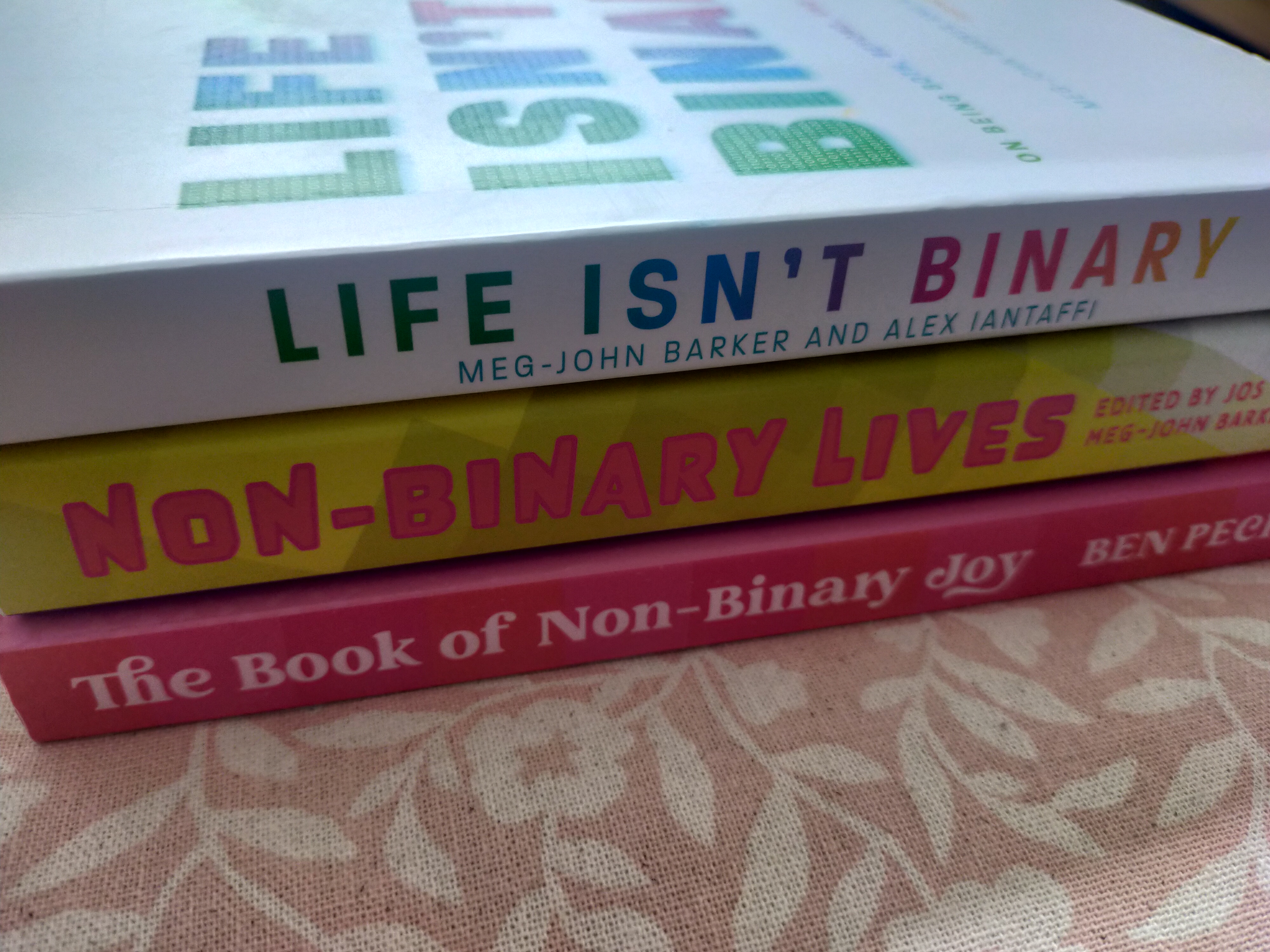
For enby folx and allies alike, these books offer a window into the world of non-binary thinking as well as non-binary lives.

Non-binary thinking sometimes has echoes of the philosophy of non-duality, associated with parts of yoga and with Buddhism.
The Zen master Thich Nhat Hanh wrote about ‘interbeing’ and how we’re all connected. In his book, Peace is Every Step, he explained how looking deeply into a single sheet of paper can show us the whole universe, the sunshine, the trees, the logger and their family, etc. He wrote (p98):
Wealth is made of non-wealth elements, and poverty is made by non-poverty elements. It is exactly the same as with the sheet of paper. So we must be careful not to imprison ourselves in concepts. The truth is that everything contains everything else.
Drawing on Thich Nhat Hanh’s teachings on non-duality, we might be able to approach our reading about non-binary lives with a more open mind.
These books aren’t aiming to provide the perfect, distilled, neat summary of what it means to be non-binary. It’s kind of the opposite – we read about non-binary lives to develop non-binary thinking, to make space for the expansiveness of life beyond the binary within our minds.
From this spaciousness emerges the the flexibility to allow others to move beyond the gender binary, whilst others still have space to explore within the binary. We can’t go beyond the binary without first recognising the binary.
Non-binary Lives

Books can be both windows into another world and mirrors reflecting our world back at us. As a non-binary (enby) person myself, I’m fascinated by the three books pictured at the top for both their mirrors and the windows.
It’s particularly special to get a window into other people’s experience of being non-binary and how this intersects with other aspects of their identity. That’s exactly what is offered by the anthology called Non-binary Lives, edited by Jos Twist, Ben Vincent, Meg-John Barker and Kat Gupta.
The book is split into four sections of different essays: Cultural Context; Communities; The Life Course; Bodies, Health and Wellbeing. There’s a huge range of topics covered from religion to jobs, autism to adolescence, finding belonging, and sometimes rejection, with an exploration of attitudes towards being non-binary in various cultures.
All the essays are intensely personal and the whole collection has a real energy. The end of Kat Gupta’s essay (p37) sums up some of the emotions running through the anthology:
Which ‘I’ am I today? It is both freedom and recklessness and danger and love, love, love for every life you could have led.
The Book of Non-binary Joy

This really is a joyful book, from the bright pink cover to the cute sketches dotted around the chapters, and the gentle loving tone throughout. It’s like a pep talk from the non-binary best friend you didn’t know you had.
Author Ben Pechey takes our hand and guides us through the world of non-binary joy. Allies are very much welcome for the journey, and there’s a whole chapter on allyship. There are also chapters on understanding your past, self-awareness, privilege, fashion, self-expression and others.
The tone is beautifully encouraging throughout, like having your own personal cheerleader – and who doesn’t need that? For example, in this topic about bullying at school, Ben writes (p47):
No matter where you are on your journey of self-acceptance and love, every day is an achievement. You must always remember this. Your trauma is not ruling you. You have chosen you. That is such an important part of loving yourself.
Life Isn’t Binary

The book’s sub-heading reads ‘On being both, beyond, and in-between’, which gives a flavour of the expansiveness of this text. Authors Meg-John Barker and Alex Iantaffi have covered a huge amount of ground, with a strong emphasis on non-binary thinking.
Life Isn’t Binary is separated into six chapters: Sexualities, Genders, Relationships, Bodies, Emotions, Thinking. There are pockets of interaction, with boxes labeled ‘reflection point’ and ‘thought experiment’, which encourage the reader to put non-binary thinking into practice.
I particularly love the sections headed ‘slow down!’ which encourage the reader to take time to digest the information. The ‘slow down!’ section on p36 asks us to become more embodied, with feet on the ground and connecting to the breath. In this way, it felt like a beautifully yogic approach to the process.
The book offers a range of lived experiences beyond the authors’ own experiences. There are also lists of useful resources at the end of each chapter relating to the theme. It draws on research but remains really readable and accessible throughout. For example on p122, the authors touch on intersectionality within their topic of ‘Bodies’, and how it’s often misunderstood as being about identity when it’s actually about systems of oppression:
Key intersectional thinkers Patricia Hill-Collins, Audre Lourde, and bell hooks all argue that binary either / or thinking is a key influence on oppression which intensifies dominance and marginalisation.
Non-duality and non-binary thinking

From the brief introductions to three non-binary texts above, you can see how the authors have tried to problematize the concepts and make space for people to show up to the page as they are.
From the perspective of non-duality, as described in Peace is Every Step, we see that non-binary ways of living and thinking can only exist because of the binary. These three non-binary books therefore, by nature, are constantly describing the binary in a bid to move beyond it. But the glimpses that this perspective provides nourish the non-binary soul.
For me, these windows into other people’s lives provided by the non-binary books impact the mirror. I never feel quite the same after dipping into these texts. There’s always something to learn and change is always happening, so the mirror never remains static. This is exactly the kind of shifting ground which suits non-binary thinking and non-dualistic thinking too.
We look deeper and deeper, and see the whole universe reflected back at us and within us.
Queer Yoga
Enjoy a bit of yoga philosophy with your LGBTQIA+ reading? If so, check out my first book due April 2026!
Pre-order your copy now:
Via the publisher, Llewellyn Worldwide
Each chapter includes an essay about one aspect of yoga philosophy, as well as sequences for mat and chair, journal prompts, rituals, visualisations, and tips for creating a home yoga practice.
Leave a Reply